
SENSE
Empowering women with personalized workout circuits aligned to their menstrual cycle.
Introduction
Closing the Women’s Health Gap: Biometric Fitness Data
Menstrual cycles is something that a community of women experience throughout their lives, however,
based on a study on from the National Library of Medicine on women’s menstrual and reproductive health literacy, 57.3% of women are not knowledgeable of the 4 phases of their menstrual cycle (MC).
This topic was interesting to me as the MC is something that several women experience, but modern fitness tools don’t take into account for their female users
This was why SENSE was designed in order to close that gap.
Problem Statement
Existing fitness tools ignore women's hormonal fluctuations, leaving them to push through workouts that do not match their body's current state.
Opportunities
✦
Generate personalized workout circuits for each menstrual cycle phase
✦
Integrate seamlessly with wearable tech such as the Oura Ring
✦
Simplify class booking through platforms like ClassPass*
✦
Supports users' emotional and physical wellbeing
Goals
✦
Understand how target users’ cycle impacts fitness
✦
Optimize workouts that match energy levels
✦
Building self-compassion into their routines
✦
Help users stay consistent and motivated in the long term
Competitive Analysis
Decoding the Competition: Uncovering Insights
Looking at the competitive space was quite challenging as I had to analyze 2 different types of applications for workouts and period tracking. The following are mobile apps I performed a competitive analysis:
Fitness
✦
Apple Fitness
✦
Sweat
✦
Nike Train Club (NTC)
Period Tracking
✦
Flo
✦
Clue
✦
Lively
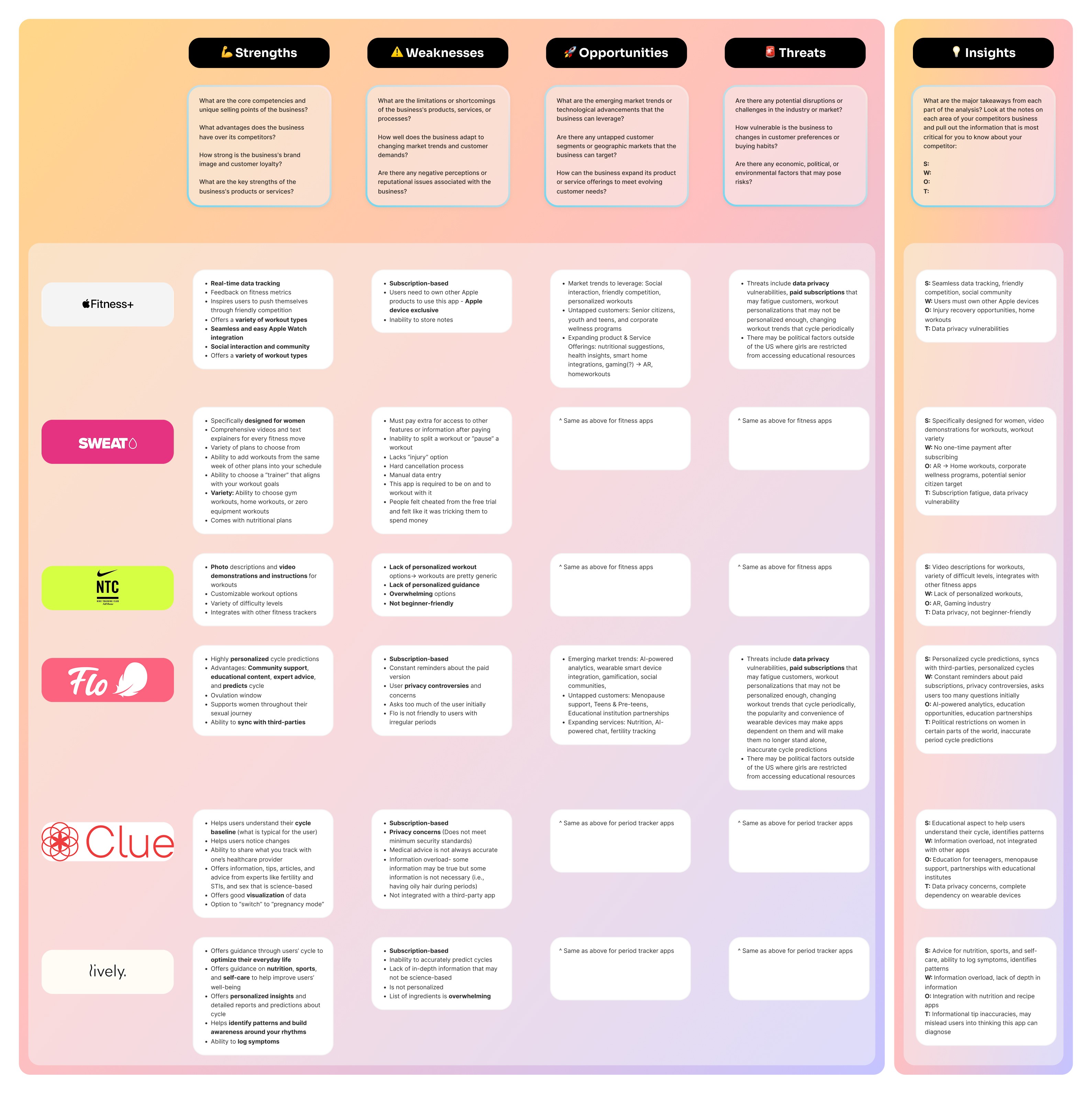
Overall Competitive Analysis Findings
With a clear understanding of user pain points, I moved to the ideation phase. The user interviews highlighted the following:
Strengths
✦
Ability to schedule and customize workouts
✦
Varying levels of workouts to appeal to different levels
✦
Personalized period tracking
✦
Predictive technology for periods
Weaknesses
✦
Subscription fatigue
✦
Not beginner friendly for workouts
✦
Data privacy concerns
✦
Predictive technology reduces users as an algorithm— it is not always accurate
User Interviews
A Mission to Understand
✦
I divided the user interview questions into understanding users’ fitness habits and how their menstrual cycles impact their fitness.
Target Audience
✦
Cis women who experience menstrual cycles
✦
Ages 22-35
✦
Women who exercise for 2+ hours/week
Methods
✦
6 user interviews
✦
8 participants for user surveys
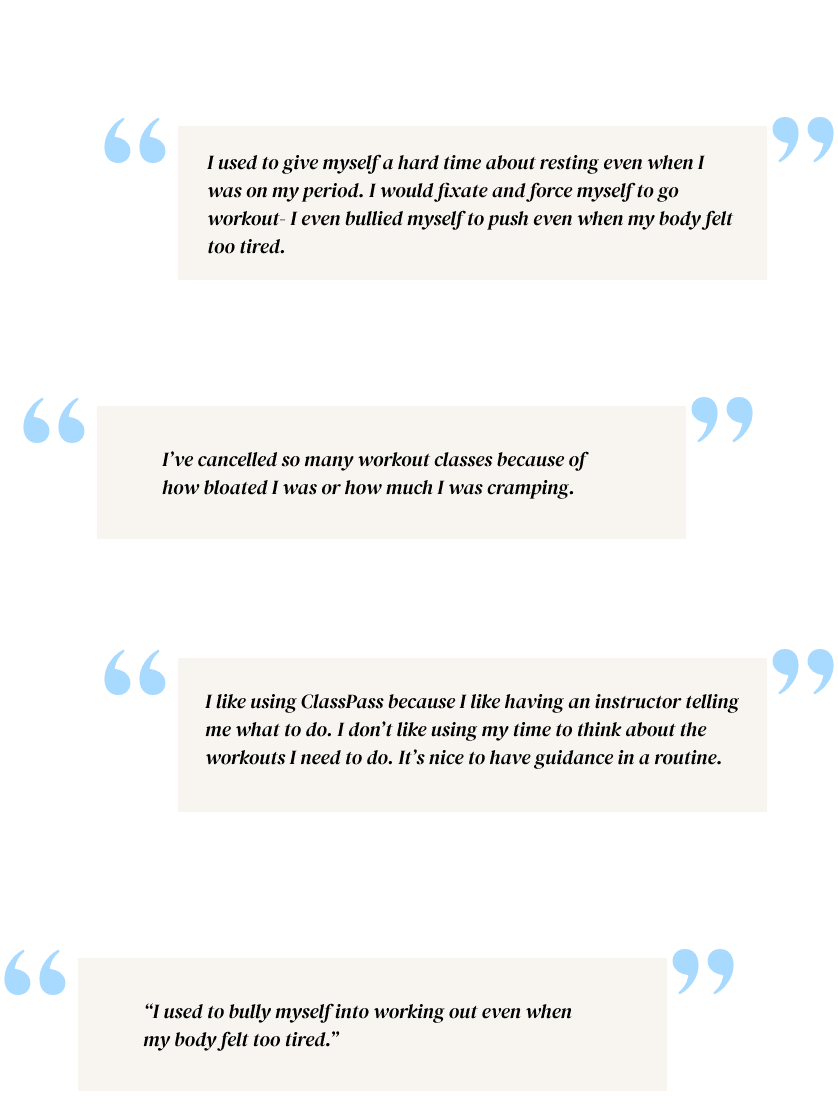
User Quotes
Assumptions
✦
Most women experience menstrual cycles.
✦
Most users are not aware of their menstrual cycle phases.
✦
Women have a negative relationship with their periods.
✦
Women are frustrated on their period and generally avoid working out at this time.
Risks
✦
Collecting data would raise user concerns and risk privacy.
✦
Finding participants who are transparent and comfortable about talking about their menstrual cycle will be difficult.
After Conducting User Interviews on 30 Women, We Found…
01
The real pain point for users working out was time management issues as time management was one of their biggest blockers.
02
Majority of users preferred guided workouts or a workout class as it reduces cognitive overload for them.
03
Users felt differences on their menstrual cycle, but they never considered how it would impact their physical performance which led to a declining mental health.
04
Participants worked out the hardest during their menstrual phase.
Other Key themes
✦
Participants pushed themselves to workout during their period even when they knew they should be resting
✦
They began to have a lot of negative thoughts when they would rest and would push themselves to be active
✦
Even though they’ve been having periods, they never thought about how it could impact their motivation
✦
Participants wanted to learn more about their periods after the interview
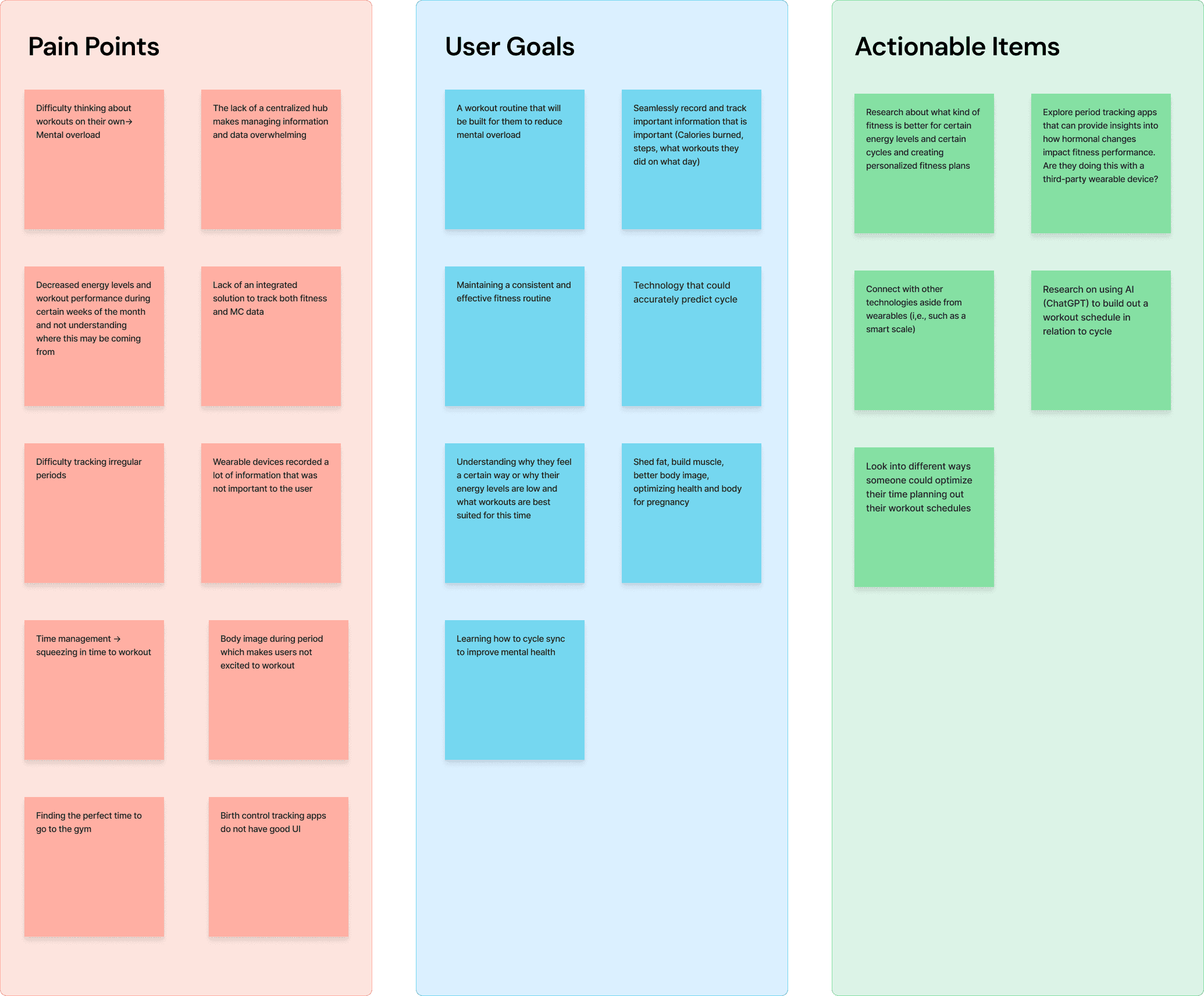
Affinity Map
User Journey
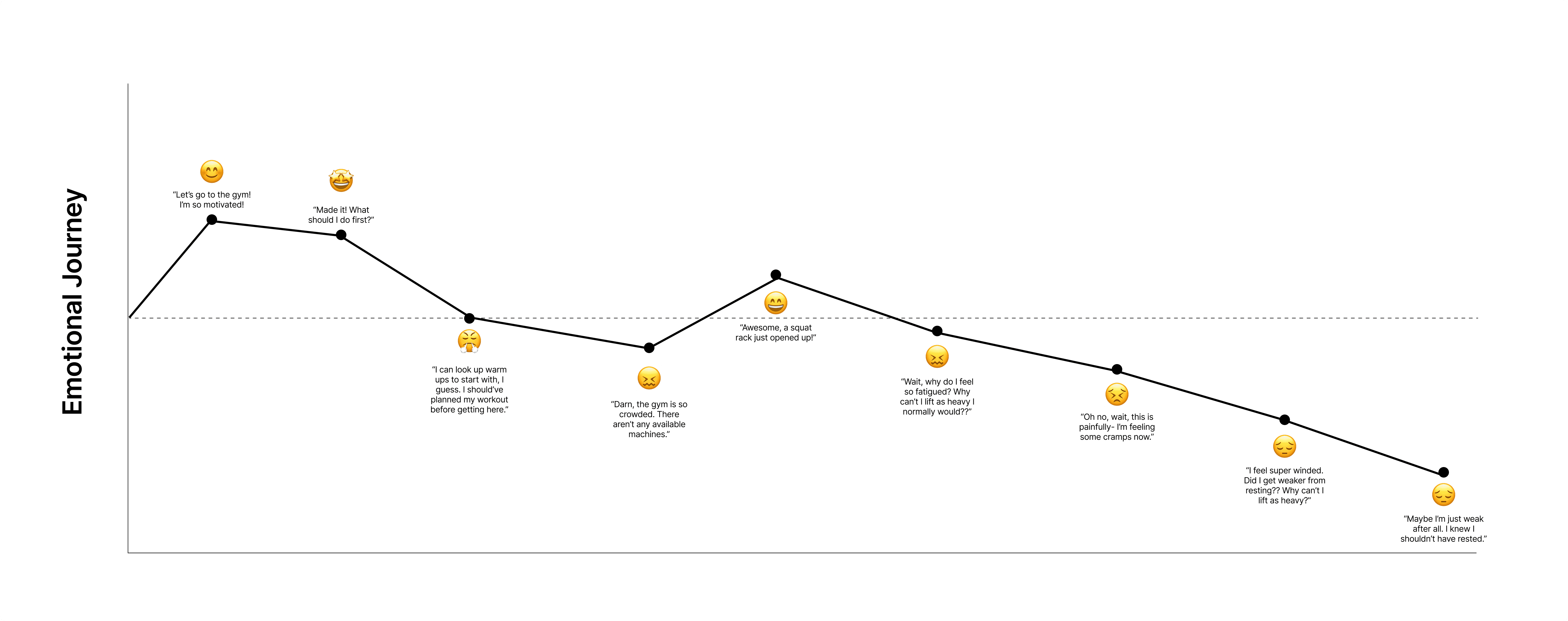
Conceptualizing: Laying the Foundation
User Flow
✦
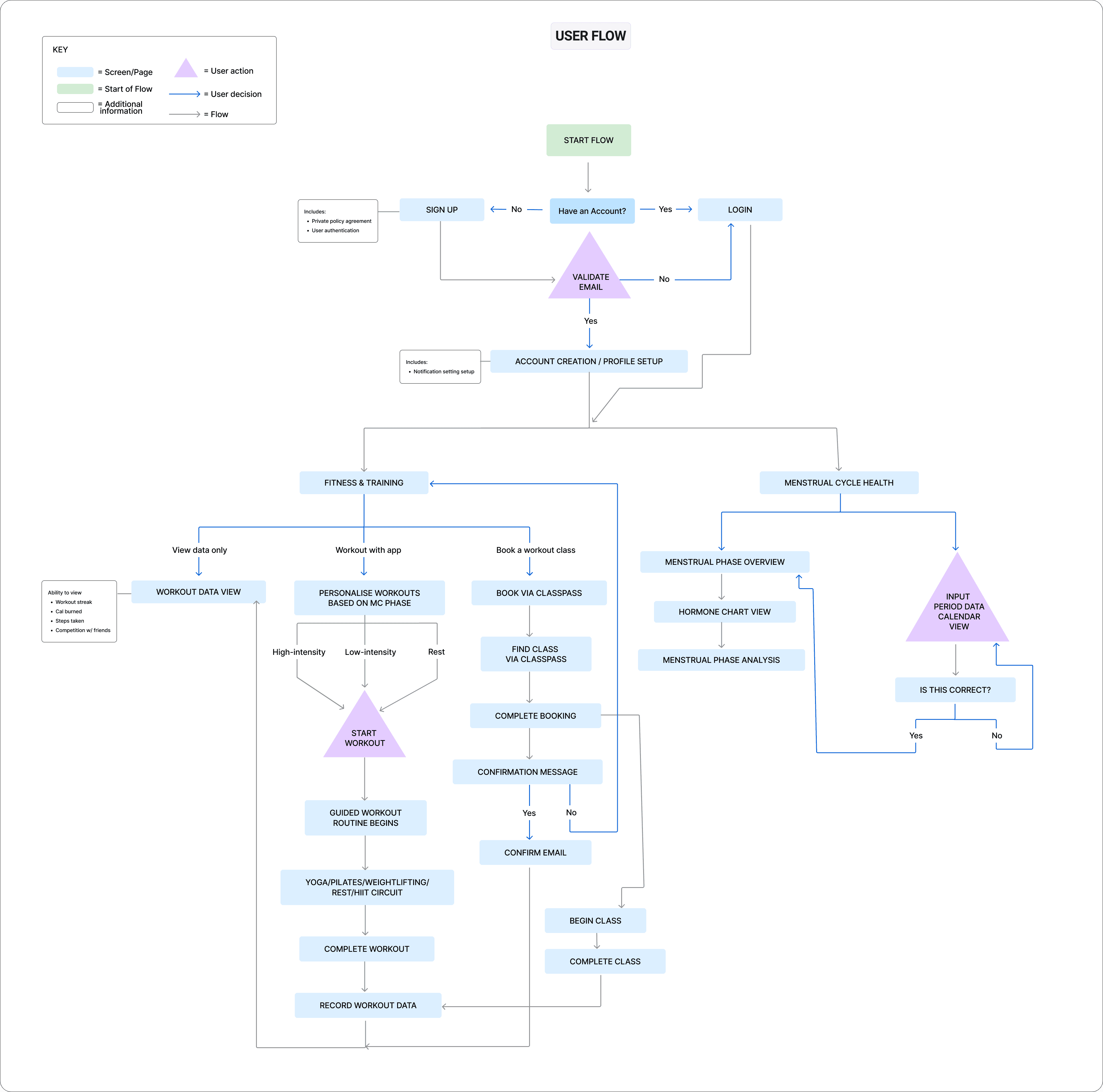
The main architecture of SENSE splits between Health (cycle tracking) and Fitness so users are not overwhelmed by too much data.
✦
Fitness & Training
I designed 3 distinct paths based on the user’s current needs:
Workout data overview which includes general data of users physical activity.
Personalized workouts — The primary feature for SENSE. Workouts are generated accordingly to the user’s logged symptoms and current cycle phase and ends with automatic data recording.
External integration with ClassPass* — I included a flow for booking local classes that still syncs back into the SENSE system for users who want to workout with instructor led classes
✦
Menstrual Cycle Health
Data input and validation — Users can manually or automatically input period data through the calendar screen which the system will reference when generating workouts.
Data analysis — Users will be able to view and analyze the MC records as they will be provided with educational tips on why certain workouts were generated/suggested.
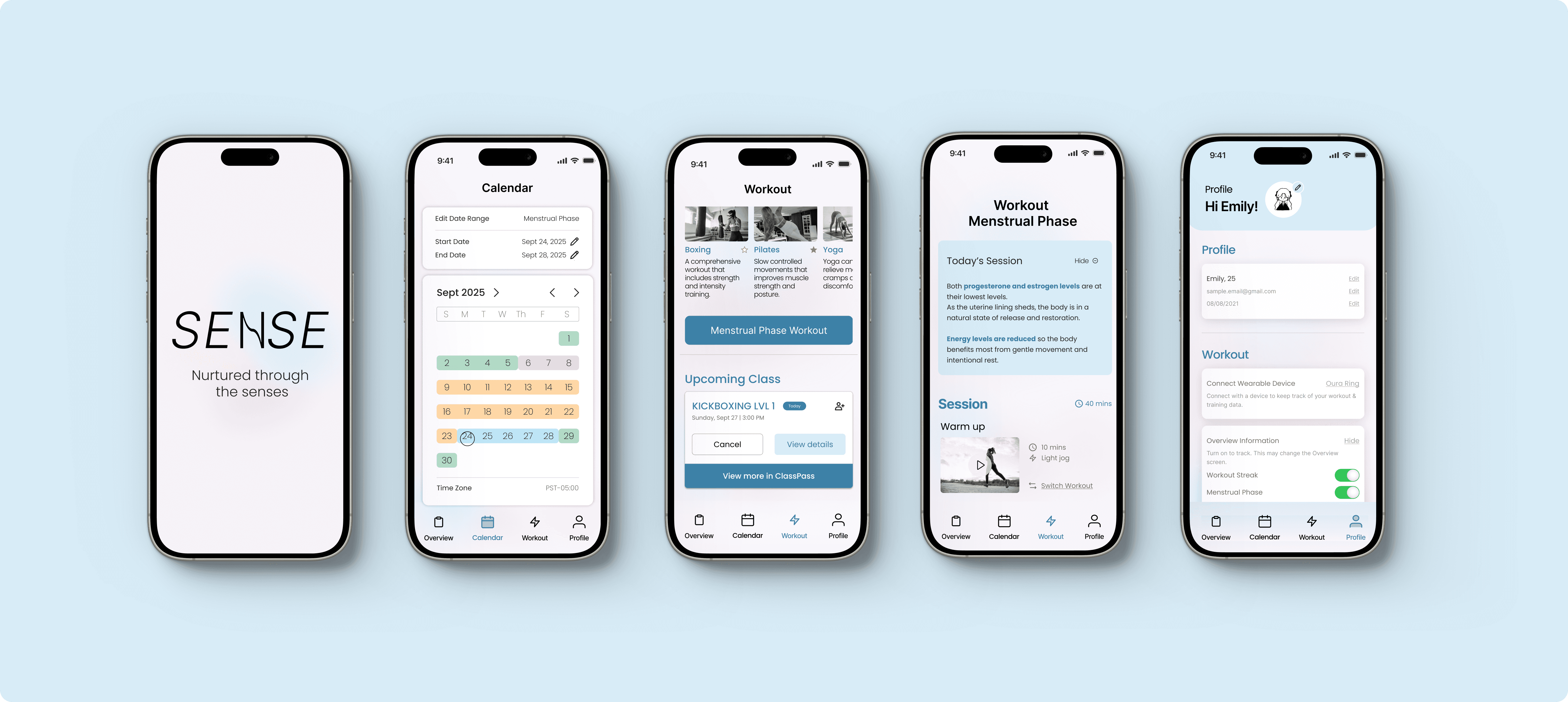
The overall structure of the product ultimately consists of the Workout Overview, Period Calendar, Workout Exploration/Generation, and User Profile.
01 Cycle Calendar
✦
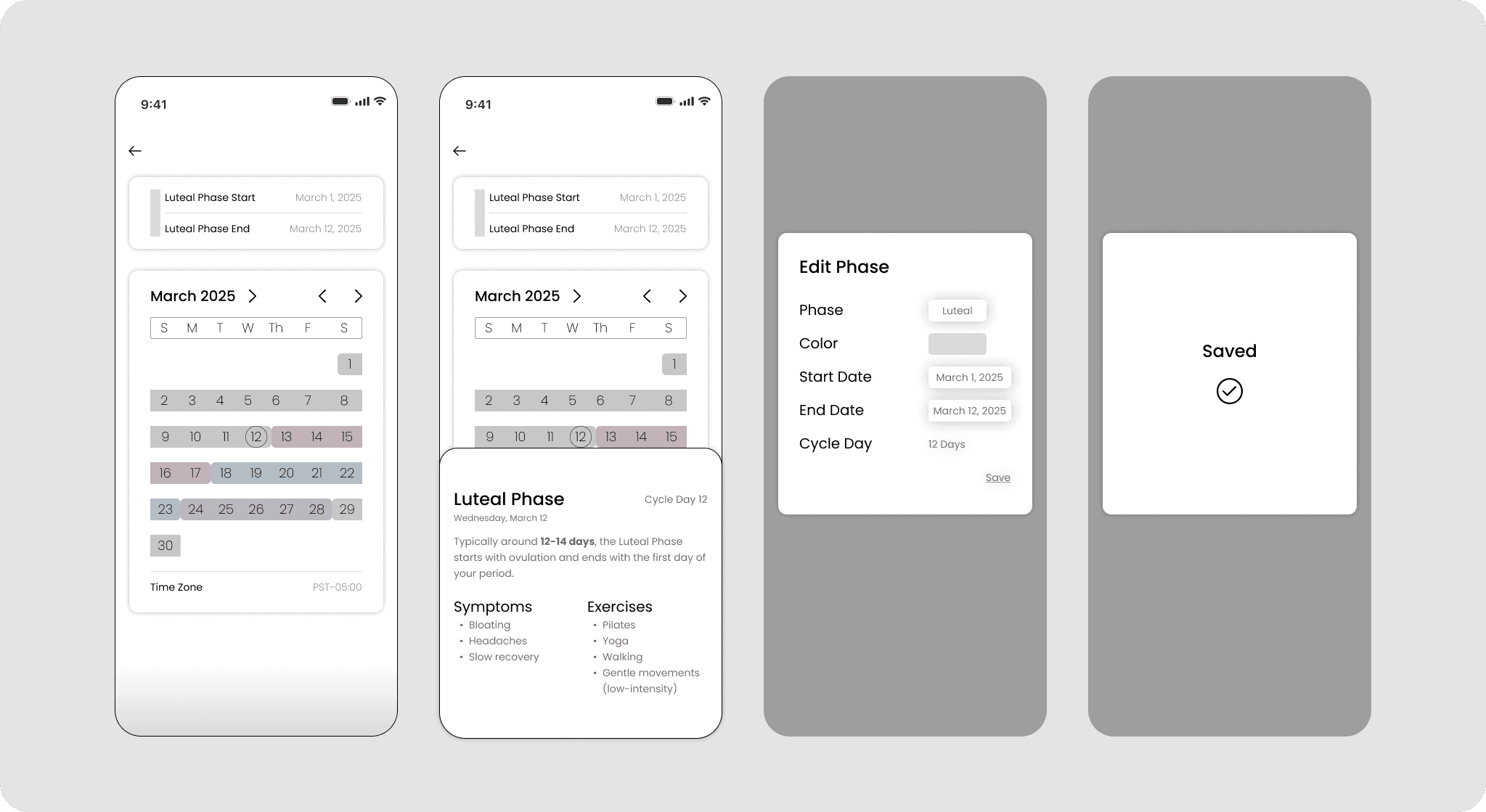
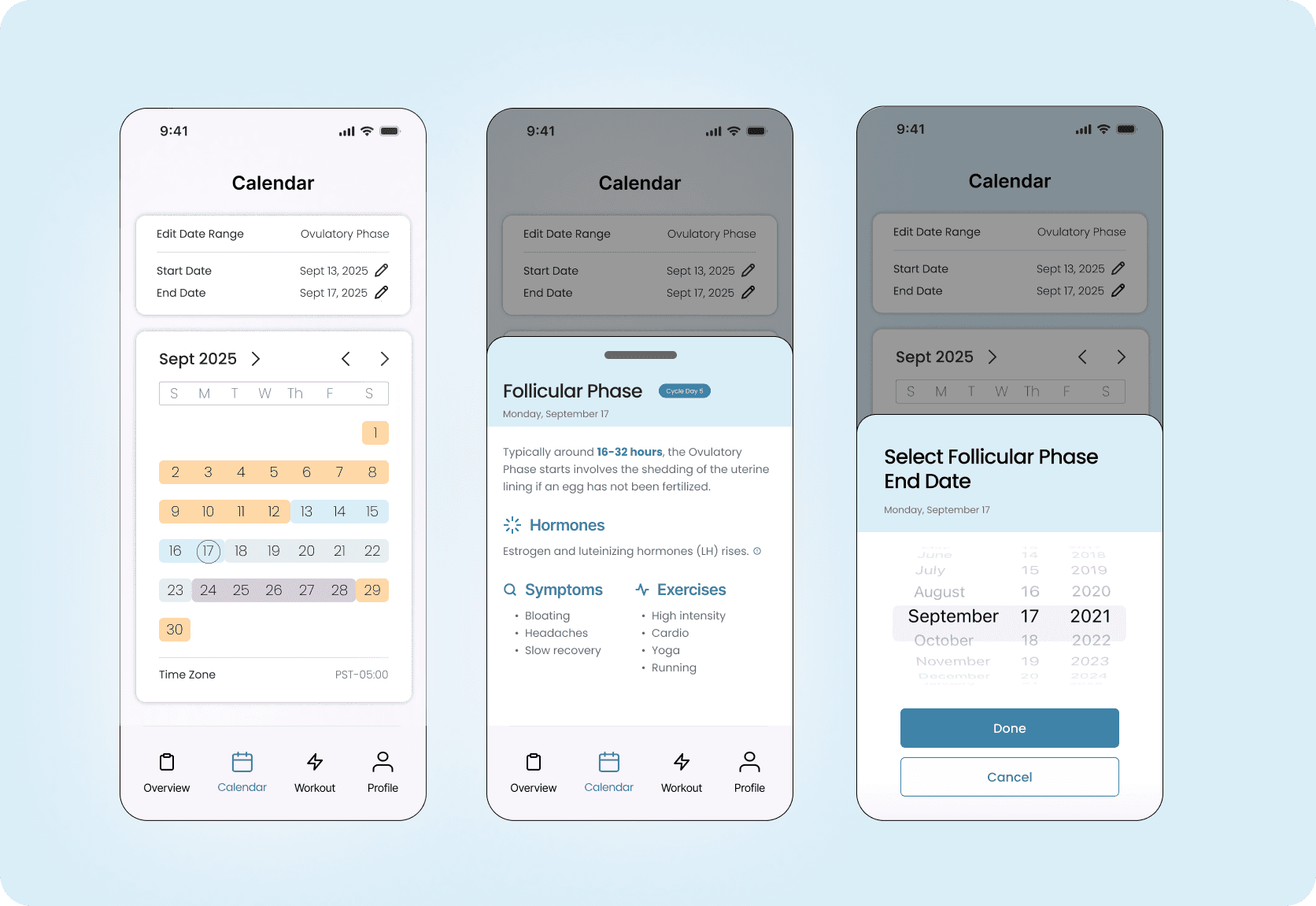
The calendar screen includes the current month as well with the current date marked with a circle. Each week is color coordinated by the phase of the cycle as recorded with the user’s biometric data such as her temperature. Users can also manually record the start date of the menstrual cycle.
✦
Tapping a date on the screen will show information regarding the cycle associated with that day, possible symptoms, and recommended exercises. Users can also edit the date ranges of those phases as well as choose a color to display in the calendar for it.
✦
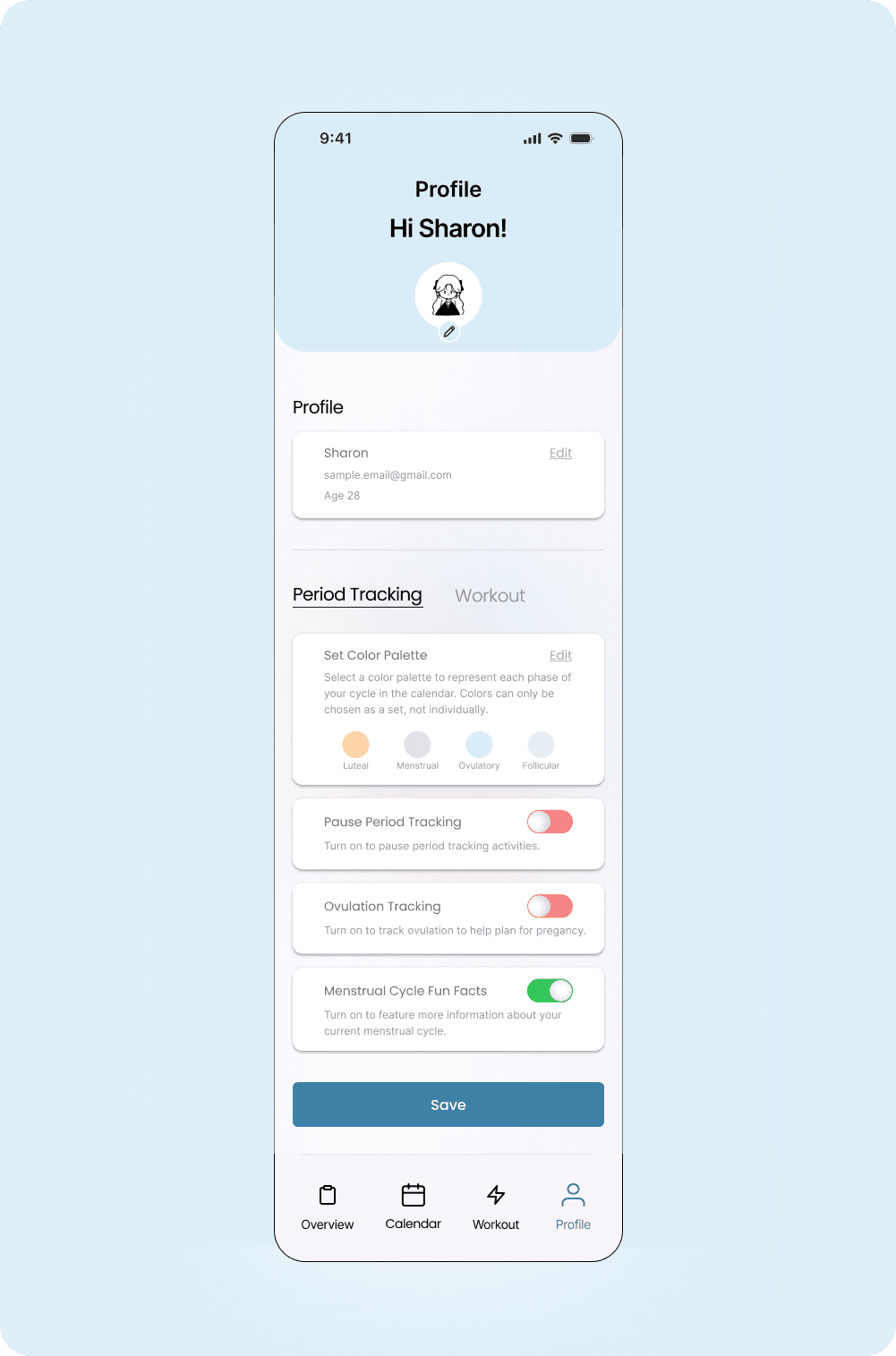
The area where users can tap to change the color palette was too small, so I designed it in the mid-fidelity design where users can easily access the color palette. Instead of allowing users to pick a color for each phase, I thought to have pre set color palettes for users to choose from to reduce cognitive load.
First Iteration
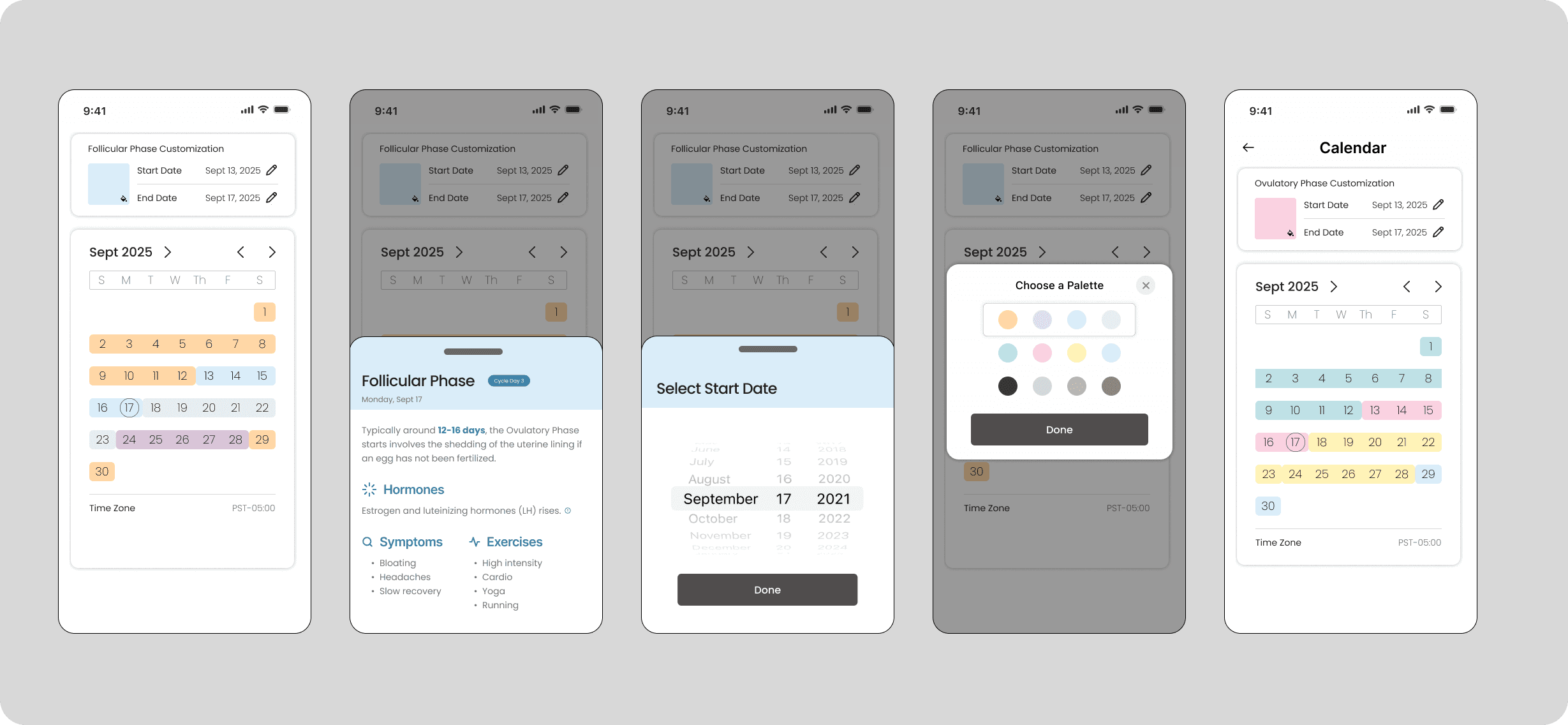
User Feedback
✦
60% of participants stated that although the ability to choose a color palette for each cycle phase as it allowed a personalized touch, it was not necessary and it may be confusing to keep up with too many colors.
✦
Solution
I moved the color customization feature out of the calendar screen to reduce the visual and cognitive complexity to keep the primary calendar workflow focused on tracking and planning. While participants did enjoy the customization option, user testing revealed that it was not essential in this context. As a result, I relocated it to the settings screen to simplify the overall experience. This change reinforced the importance of separating core tasks from secondary personalization features to maintain focus and reduce friction.
Final Iteration
02 Workout Generation
✦
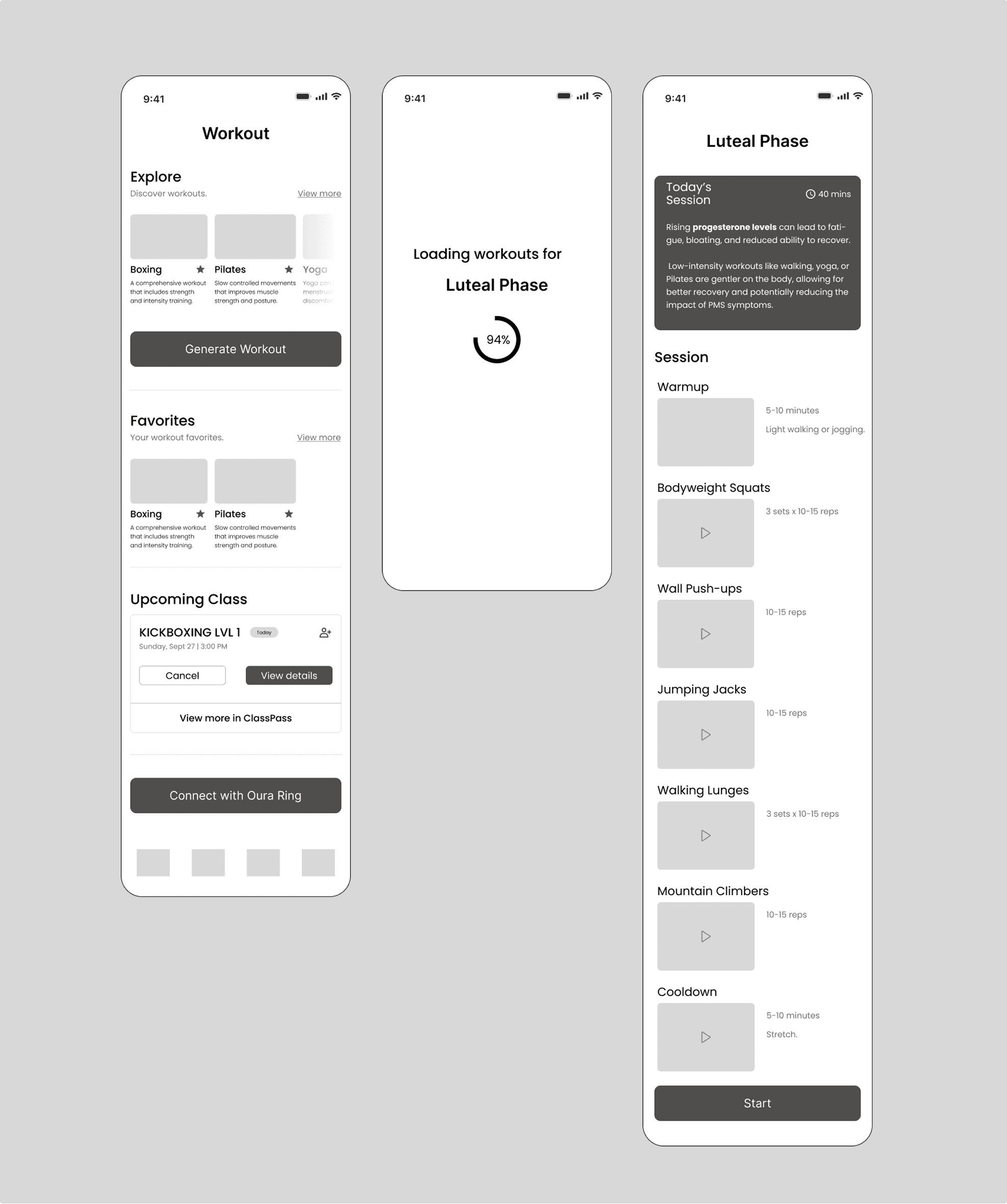
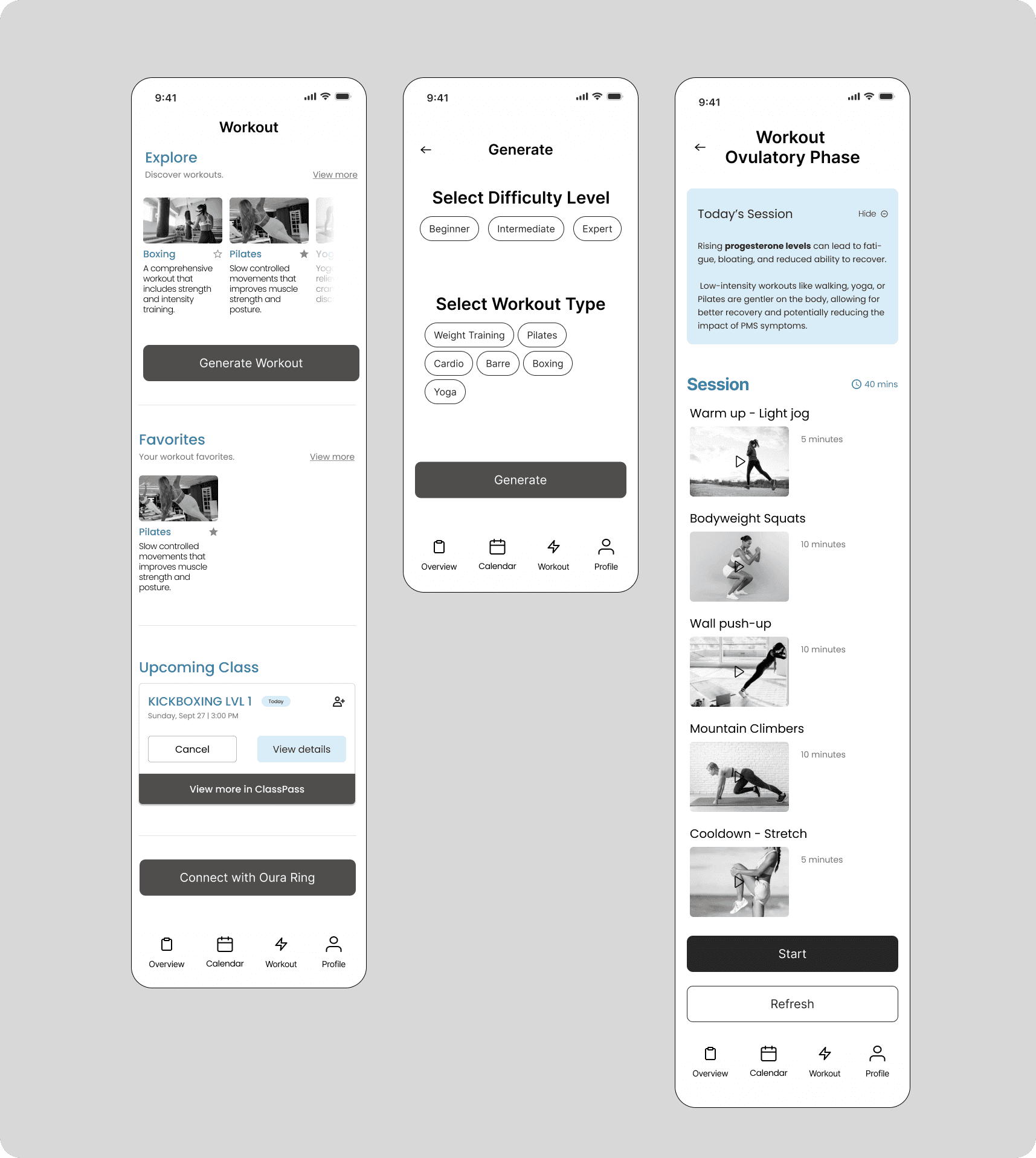
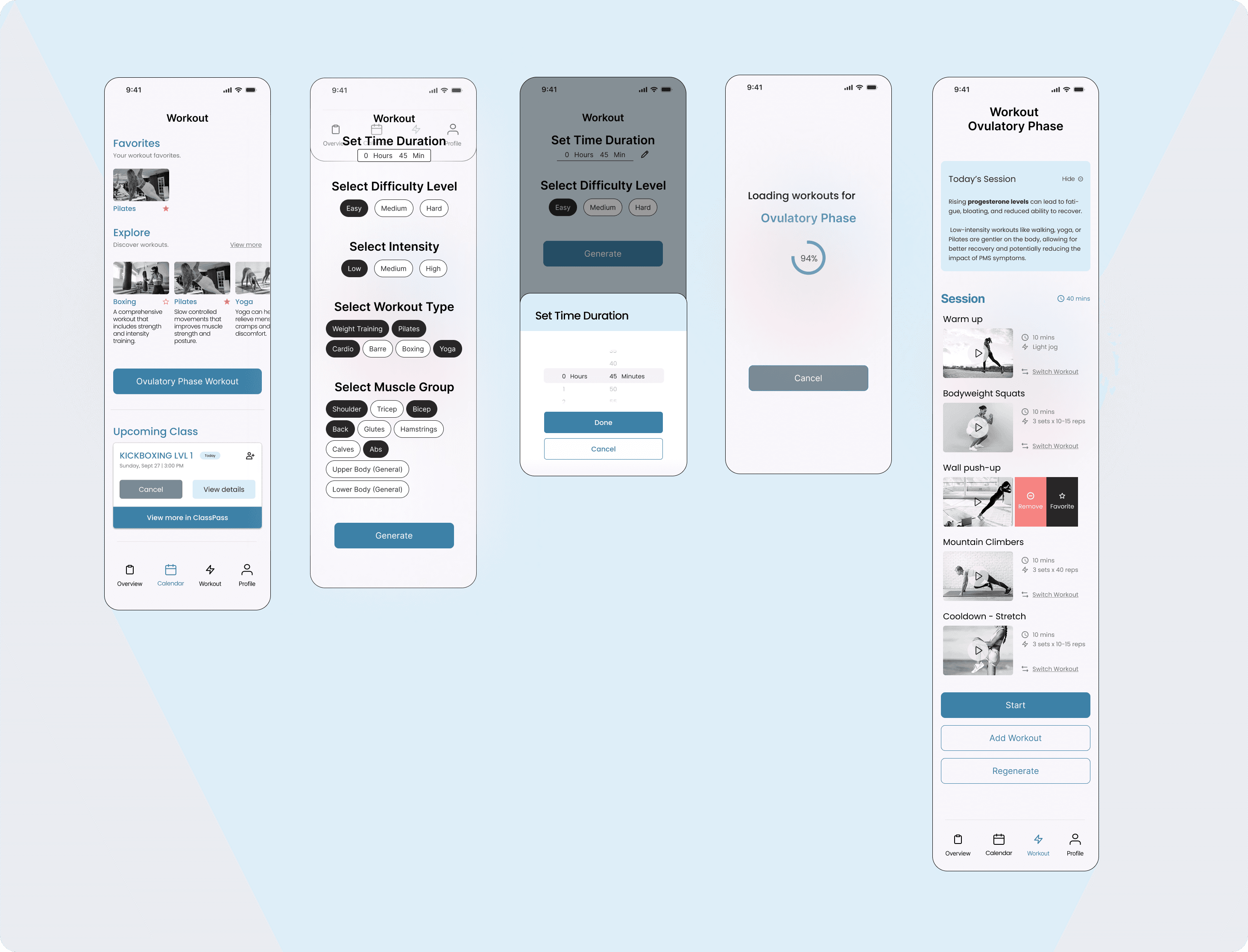
The workout generation screen allows users to explore workouts, view their favorite workouts, generate a workout, and view their upcoming workout class booked through ClassPass.
Low-fidelity Wireframes
First Iteration
User Feedback
✦
70% of participants stated that they did not think the workout generation portion of the application had enough customizations as they wanted to be able to have the option to set the following:
✦
How intense the workout would be
✦
The type of workout they wanted to do
✦
Targeting certain muscle group(s)
✦
Workout duration
This feedback reinforced that menstrual experiences and fitness preferences are not universal. It was a good reminder as a designer that data-driven personalization must still be balanced with user autonomy. After all, I wanted to design a mobile experience that allows for users to feel more in sync with their biology instead of forcing them into rigid cycle-based rules and data.
Final Iteration
✦
The final iteration gives users full control over generating their workout by allowing them to define the duration, difficulty, intensity, workout type, and muscle group. By shifting personalization in to the user’s control, the experience became more flexible and responsive to individual needs. In follow up testing, 100% participants described the workout generation flow as highly personalized and aligned with how they personally preferred to train.
The Final Design


Reflection
Final thought
Overall, this project taught me so much. I learned to lean more on evidence when making design decisions instead of relying on pure instincts.
I also learned that good design didn't always mean solving a problem outright or getting users to complete 100% of tasks in a usability test.
It's about understanding and connecting with people at a human level.
For the women who were a part of this project, I learned about their pain and repercussions especially when pushing their bodies to its limits.
The most rewarding part of this project was feeling like I was contributing to a real solution for a real problem.
Design limitations
✦
Edge cases such as users who experience irregular cycles, PCOS, endometriosis, or who are on hormonal birth control.
✦
Sampling bias in research as I only included women who were comfortable about talking about their menstrual cycles. The other population of women who may feel frustrations but were more private about this topic were not represented in this study.
Technical limitations
✦
13% chance that workouts can be generated incorrectly.
Recent research shows that biometric data from wearables can identify menstrual cycle phases with up to 87% accuracy (e.g., differences in heart rate, temperature, and sleep) to enable fitness experiences that adapt to a woman’s body in real time rather than relying on static workout programs (Kilungeja et al., 2025).
✦
Potental data privacy/security risks.
If I could go back in time and redo this project, I would…
✦
Run a longer term user research phase to collect more data.
✦
Include data security and privacy earlier into the research and design phase.
✦
A/B testing final designs.
✦
Consider other tools for wearables to pair with.
Future ideas for SENSE
✦
Implementing goal based workouts such as strength building, isometrics, and fat loss.
✦
Implementing a feature for adding friends and allowing them to have friendly competitions with one another.
✦
Including other biometric data such as BMI.
✦
Including goal based workouts like weight lifting or fat loss.
✦
Include the ability to log symptoms or have a diary.
✦
Include food suggestions for each phase.
✦
Dark mode
Citation
Kilungeja, G., Graham, K., Liu, X., & Nasseri, M. (2025). Machine learning-based menstrual phase identification using wearable device data. Npj Women’s Health, 3(1). https://doi.org/10.1038/s44294-025-00078-8